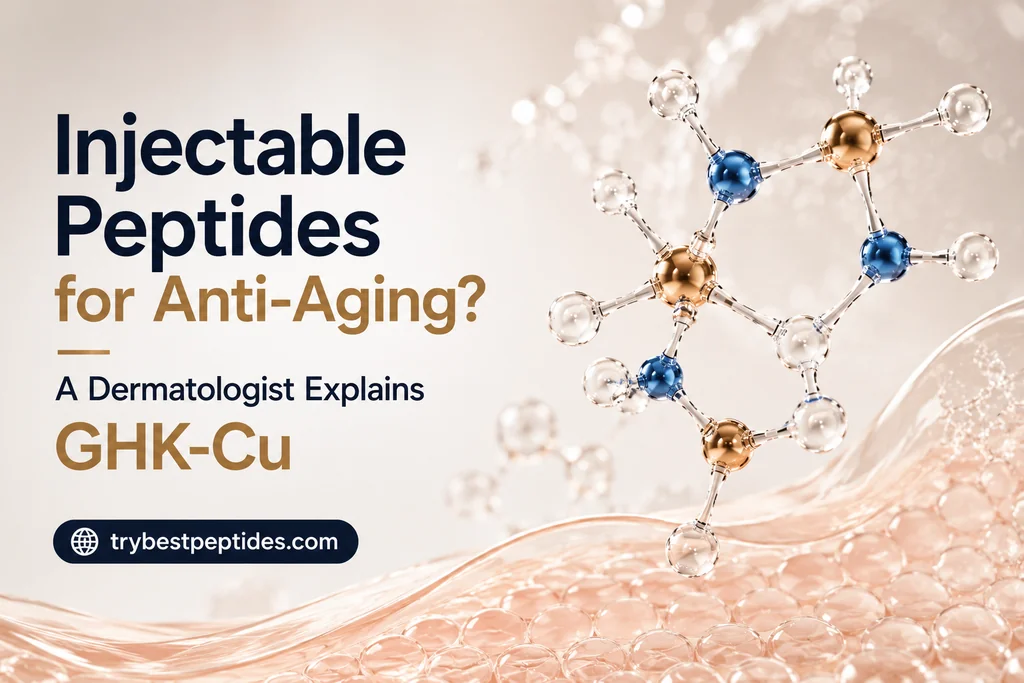
Injectable peptides have taken over social media, with influencers touting GHK copper as a miracle solution for wrinkles, hair loss, and even longevity. But here's what you need to know before jumping on the trend: the research supporting injectable peptides is far more limited than the hype suggests, and the safety concerns are rarely discussed. As a board-certified dermatologist, I see patients asking about these treatments constantly—and while GHK copper is indeed a fascinating molecule with real biological activity in the body, the disconnect between what the science actually shows and what's being marketed online is significant. In this article, we'll break down exactly what GHK copper is, examine what the clinical data reveal, and discuss the serious risks that often go undisclosed. Understanding the difference between promising lab results and proven human benefits could save you from making a costly—or dangerous—mistake.
What Is GHK Copper, Really?
GHK copper is a peptide made up of three amino acids: glycine, histidine, and lysine. This is where the "GHK" comes from. It's a naturally occurring compound found in human plasma—meaning it exists in your body right now. Here's the interesting part: we have significantly higher levels of GHK in our 20s (around 200 ng/mL) compared to our 60s (around 80 ng/mL).
When GHK binds to copper, it forms what researchers call "copper tripeptide-1" or simply GHK copper. This complex has been studied for decades, particularly for its potential role in wound healing and tissue repair. Mechanistically, GHK copper acts as a signaling molecule in the body—it's released when collagen breaks down and essentially tells your tissues, "Hey, we need to repair this damage." This biological plausibility is part of why the peptide has attracted so much attention.
The Role of Copper in Skin Health
Copper is essential for the function of enzymes that produce collagen and elastin. This is a real biochemical fact, not speculation. If GHK copper can effectively deliver copper to target tissues, there's legitimate reason to think it might support collagen production. This is why the peptide has theoretical appeal for anti-aging applications.
The Research on Skin Benefits: Where the Hype Breaks Down
Let's be crystal clear about something: most of the research supporting GHK copper comes from in vitro studies—that means cells in a dish, isolated from the complexity of a living human body. These laboratory studies do show promise. GHK copper appears to increase growth factors like VEGF (vascular endothelial growth factor) and fibroblast growth factor, both necessary for healthy blood vessel formation. It may stimulate fibroblasts to produce collagen and elastin. It appears to have antioxidant and anti-inflammatory properties.
But here's where we need to pump the brakes.
The human clinical trials are remarkably limited and small. Not robust. Not sufficient to draw meaningful conclusions about anti-aging effects. When influencers claim that GHK copper will "boost collagen and reverse aging," they're extrapolating from experimental models—not from proven results in humans. There's biological plausibility, sure. But plausibility isn't proof. Some small clinical studies suggest that applying GHK copper topically may help improve skin texture and wound healing, but even this evidence is modest at best.
The fundamental problem: we simply do not have high-quality human studies demonstrating that GHK copper meaningfully reduces wrinkles or improves skin aging.
Topical vs. Injectable: A Critical Distinction
This is important. You might find GHK copper in skincare products—The Ordinary, for example, makes a copper peptide serum. When applied topically, GHK copper is generally considered very low risk. The catch? The skin's job is to keep things out. Topical peptides have extremely limited penetration. Any effects you see are likely modest and may simply come from hydration—something any humectant in a skincare product can provide.
Injectable forms are an entirely different animal. They bypass the skin barrier. They enter your bloodstream. They're poorly researched and unregulated for cosmetic use.
The Hair Growth Claims: More Promising, But Still Incomplete
Here's where GHK copper gets the most attention. Hair loss is a real problem for millions of people, and people are desperate for solutions. The mechanism sounds plausible: copper peptides may reduce TGF-beta (which is elevated in balding scalps) while increasing VEGF to improve blood flow to hair follicles. Lab studies even suggest GHK copper can promote hair shaft elongation.
One small retrospective study combined GHK copper with minoxidil and dutasteride for scalp infusions. Some patients showed improvement. But—and this is a significant but—the study lacked a control group, it was tiny, and it couldn't isolate which treatment was actually responsible for results. This falls far short of establishing GHK copper as a standard of care for any hair loss condition.
Why Hair Growth Is Different
Hair growth is metabolically demanding. It requires consistent oxygen and nutrient delivery via blood flow. If GHK copper genuinely improves vascularization, that could theoretically help. But "theoretically" and "proven in humans" are worlds apart. We need actual clinical trials with control groups before we can claim injectable GHK copper grows hair.
The Longevity and Brain Health Claims: Reaching Too Far
Animal studies suggest GHK copper might reduce brain inflammation and improve memory tasks in mice. You know what's not a mouse, though? You. Human neurobiology is incomprehensibly more complex than rodent models. Throughout the history of science, findings in mice frequently fail to translate to humans. We have zero clinical trials showing that GHK copper improves longevity, brain health, memory, or cognitive function in people.
These claims are, at this point, speculative at best.
The Real Issue: Safety, Regulation, and Unknown Risks
This is where the conversation shifts from "the evidence is weak" to "this could actually harm you." And nobody's talking about it.
Many injectable peptides, including GHK copper, are marketed through compounding pharmacies or research chemical websites. Here's the reality: these products are not FDA-approved for human use. There is no standardized dosing. There is virtually no human safety data. They're not regulated like medications. This means you can encounter serious issues with purity and contamination. You have no way of knowing what you're actually injecting.
The VEGF Problem
Remember how we discussed that GHK copper increases VEGF to improve blood vessel formation? Here's the uncomfortable truth: elevated VEGF is a hallmark of cancer development. Cancers thrive on new blood vessel formation. Many anti-cancer medications work by blocking VEGF to stop tumors in their tracks. If you're chronically elevating VEGF through repeated peptide injections, what are you really doing to your long-term health? We don't know. There's no long-term safety data.
Natural Doesn't Mean Safe to Inject
People say, "But it's naturally occurring in your body, so it must be safe!" This is flawed logic. Consider water. You're approximately 65% water. Water is essential for life. But if you inject water directly into your veins, blood cells will lyse. Hemoglobin gets trapped in your kidneys causing organ failure. Potassium spills everywhere causing fatal hyperkalemia. You could die.
The amount matters. The timing matters. The route of administration matters. The location matters. These are fundamental pharmacological principles that have not been worked out for any of these injectable peptides. Injecting something is not the same as consuming it or applying it topically.
Comparing Injectable to Topical Administration
The difference cannot be overstated. Topical GHK copper in a skincare product? Generally low risk. Limited effects, but also limited danger. Your skin barrier is designed to protect you from external substances. You're getting modest hydration benefits at worst.
Injectable peptides bypass that entire protective system. You're introducing an unregulated, unstandardized compound directly into your body. The potential for serious adverse effects expands dramatically. There are small studies examining GHK copper injection for wound healing in limited, specific circumstances—but these lack long-term follow-up. We simply cannot conclude that chronic injection in otherwise healthy people is safe.
What the Evidence Actually Supports
Let me be direct: GHK copper is a genuinely interesting molecule with real biological activity. It plays a legitimate role in wound healing, tissue repair, and inflammatory regulation. The basic science is sound.
But—and this is crucial—the current evidence is almost entirely relegated to preclinical studies: cells in dishes, animal models, controlled laboratory conditions. The human clinical trials that exist are small, limited, and insufficient to support the claims being made. Topical applications might offer modest benefits for skin texture and hydration. Injectable forms? Unproven, unregulated, and potentially risky.
The trend of injecting various peptides for longevity and anti-aging benefits is not supported by robust research. Meanwhile, the potential for serious adverse effects is real and often minimized or ignored entirely.
Making Smart Choices About Your Health
If you're genuinely interested in improving skin appearance or addressing hair loss, there are evidence-backed approaches that actually work. My channel covers well-established therapies and topicals—treatments with real clinical support and proven safety profiles.
Before jumping on any trend, step back. Look at what the actual research shows. Recognize that influencers have financial incentives to sell you something. That incentive doesn't necessarily align with what's safe or effective for you. The people promoting these peptides are making money from your purchases. That's how they sustain their business model.
Be skeptical. Ask for the human clinical trials. Ask about long-term safety data. Ask why these products aren't FDA-approved if they're so beneficial. These are reasonable questions, and if someone can't answer them, that's telling.
Sunscreen remains one of the most evidence-backed anti-aging interventions available. So do retinoids. So do established hair loss treatments like minoxidil and finasteride. These have decades of human clinical data behind them. They work. They're safe when used appropriately.
That's where your attention should be—on treatments that have earned their credibility through rigorous science, not through social media hype.
Key Takeaways:
- GHK copper is naturally occurring and biologically active, but research supporting injectable use in humans is severely limited to laboratory studies and animal models—not robust clinical trials
- The gap between safety and efficacy data is massive: injectable peptides are unregulated, unstandardized, and carry unknown long-term risks including potential increases in cancer-promoting growth factors like VEGF
- Topical GHK copper in skincare is generally low-risk but offers modest benefits that may simply reflect hydration from any humectant; injectable forms bypass skin protection and open you to serious adverse effects
- Evidence-backed treatments for skin aging and hair loss already exist (retinoids, sunscreen, minoxidil, finasteride); these have decades of human safety and efficacy data rather than speculation and hype
-