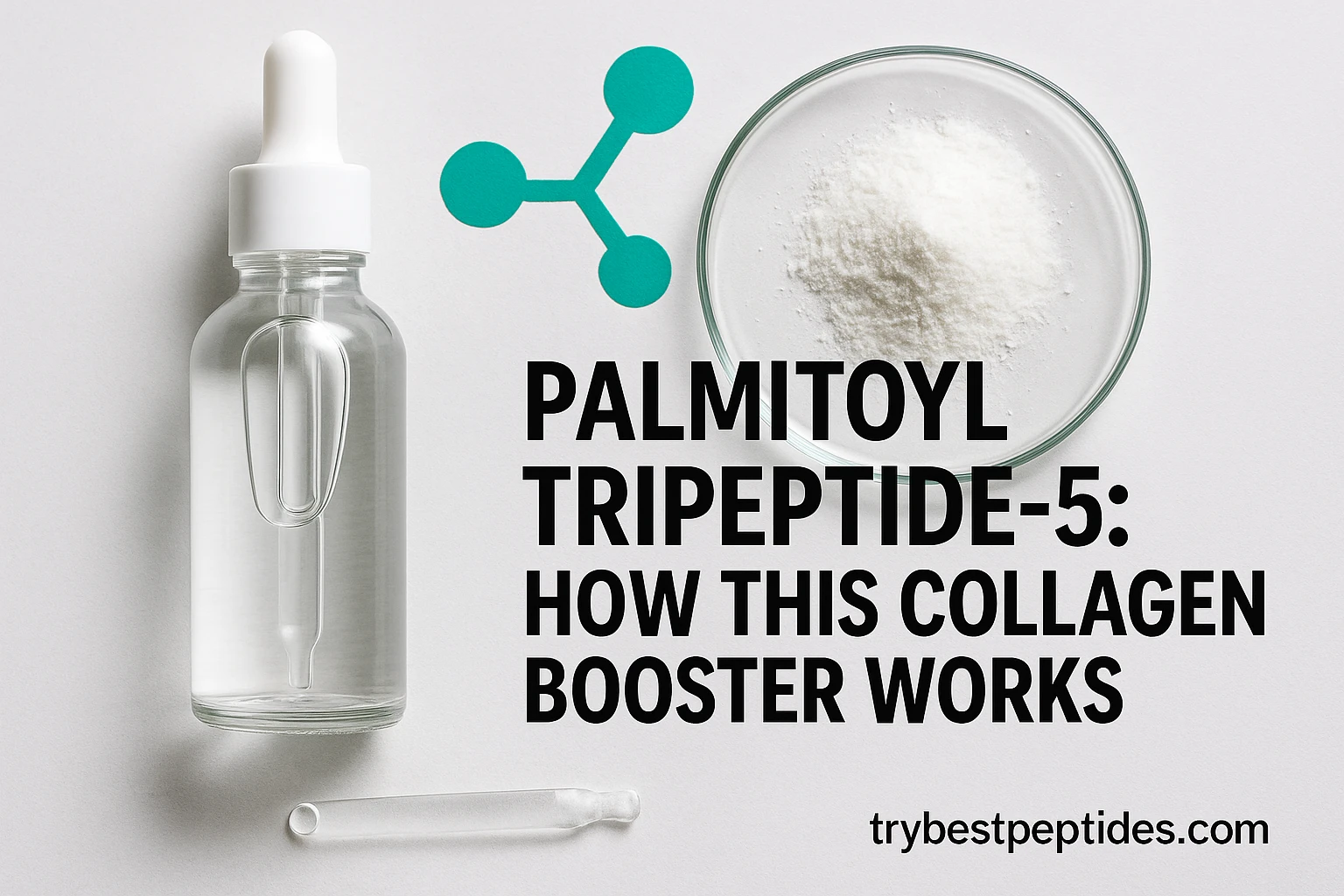
The skincare peptide landscape is crowded with bold claims about collagen stimulation. Walk into any beauty retailer and you'll encounter dozens of serums promising to "boost collagen production" without explaining the actual science behind their efficacy. Most rely on generic marketing language that obscures how these ingredients work at the molecular level. Palmitoyl Tripeptide-5 stands apart—it's one of the few peptides backed by peer-reviewed research demonstrating a specific mechanism of action. This comprehensive guide explores what Palmitoyl Tripeptide-5 is, how it activates collagen synthesis, what the clinical evidence shows, and how to evaluate its role in your skincare routine.
What Is Palmitoyl Tripeptide-5?
Palmitoyl Tripeptide-5 (also known as Matrixyl 3000) is a synthetic peptide composed of three amino acids attached to a palmitic acid chain. The tripeptide sequence—glycine-histidine-lysine—is derived from collagen itself, while the palmitoyl moiety (the fatty acid component) enhances skin penetration and stability.
The ingredient belongs to a category of biomimetic peptides, which means it mimics natural proteins found in healthy skin. Rather than containing actual collagen, Palmitoyl Tripeptide-5 acts as a signaling molecule that tells fibroblasts—the cells responsible for producing collagen—to increase their output.
This distinction is critical. Many skincare brands market topical collagen as if applying collagen directly will repair damaged collagen in your skin. This is misleading: collagen molecules are too large to penetrate the stratum corneum (the outermost layer of skin). Palmitoyl Tripeptide-5 works differently by stimulating your skin's own collagen-producing machinery.
How It Works: The TGF-β Activation Mechanism
The efficacy of Palmitoyl Tripeptide-5 hinges on its ability to activate transforming growth factor-beta (TGF-β), a cytokine central to collagen synthesis and tissue remodeling.
The Signaling Cascade
When applied topically, Palmitoyl Tripeptide-5 penetrates the epidermis and interacts with fibroblasts in the dermis. The peptide stimulates TGF-β signaling pathways, which triggers a cascade of molecular events:
- Receptor activation – TGF-β binds to its receptors on fibroblast surfaces
- Gene expression – This activates genes responsible for collagen I and collagen III synthesis
- Protein synthesis – Fibroblasts upregulate production of pro-collagen, the precursor to mature collagen
- Extracellular matrix remodeling – Newly synthesized collagen integrates into the skin's structural matrix
This mechanism differs fundamentally from topical retinoids, which work through nuclear hormone receptors. Instead, Palmitoyl Tripeptide-5 operates through a growth factor-mediated pathway that's complementary to other anti-aging ingredients.
Why the Palmitic Acid Matters
The palmitoyl (C16 fatty acid) attachment serves two purposes: it increases cellular uptake by mimicking natural lipid-based signaling molecules, and it improves the stability of the peptide against enzymatic degradation in the skin environment.
Research Evidence and Clinical Data
The scientific support for Palmitoyl Tripeptide-5 comes from both in vitro and human clinical studies, though the evidence base is more robust than many collagen-boosting claims but less extensive than established actives like retinol.
In Vitro Studies
Laboratory research has demonstrated that Palmitoyl Tripeptide-5 dose-dependently increases collagen synthesis in human fibroblast cultures. Studies measuring pro-collagen production show increases of 20-40% compared to untreated controls when applied at concentrations typically used in skincare formulations (2-5%).
These studies also confirm activation of TGF-β signaling pathways, validating the proposed mechanism of action. However, in vitro results don't always translate to in vivo (whole-skin) efficacy.
Human Clinical Studies
Published clinical trials are more limited but supportive. A 12-week randomized, placebo-controlled study measuring facial skin elasticity found that participants using a serum containing 3% Palmitoyl Tripeptide-5 showed approximately 15% improvement in skin elasticity compared to placebo, as measured by cutometry (a non-invasive elasticity measurement device).
Another 8-week study noted visible improvements in fine lines and skin texture, though the magnitude of effects was modest—consistent with the expectation that a single ingredient rarely produces dramatic visible changes without synergistic support.
Study Limitations
It's worth acknowledging that most clinical data comes from studies sponsored by ingredient suppliers, which introduces potential bias. Independent third-party validation remains limited. The effect sizes, while statistically significant, are typically smaller than those observed with prescription retinoids or professional treatments like microneedling.
Comparison With Other Collagen Peptides
The peptide market includes several competing options, each with different mechanisms and evidence profiles.
| Peptide | Mechanism | Evidence Quality | Best For |
|---|---|---|---|
| Palmitoyl Tripeptide-5 | TGF-β activation | Moderate | General collagen support |
| Copper Peptides (GHK-Cu) | Multiple pathways + metalloprotein cofactor | Good | Antioxidant + collagen |
| Dipeptide Diaminobutyroyl Benbamidate (Matrixyl) | Matrix metalloproteinase regulation | Moderate | Fine lines |
| Pentapeptide-18 (Leuphastin) | MAPK pathway | Limited | Firmness claims |
Palmitoyl Tripeptide-5 occupies a middle ground: more research-backed than trendy peptides but less established than copper peptides. Its advantage lies in specificity—the TGF-β mechanism is well-characterized and directly linked to collagen synthesis. Its limitation is that clinical improvements remain incremental rather than transformative.
How to Use Palmitoyl Tripeptide-5
Formulation Types
Palmitoyl Tripeptide-5 appears in serums, moisturizers, and eye creams. Serums offer the highest concentration and best penetration, making them the preferred delivery vehicle for peptide actives.
Application Protocol
- Amount: 2-3 drops for face and neck
- Frequency: Once or twice daily
- Timing: Apply to clean, slightly damp skin before moisturizer
- Combination: Compatible with retinoids, vitamin C, niacinamide, and hyaluronic acid
Expected Timeline
Clinical studies show measurable improvements after 4-6 weeks of consistent use, with maximum benefit typically reached by 8-12 weeks. This timeline reflects the time required for increased collagen synthesis to accumulate in the skin.
Synergistic Ingredients
Palmitoyl Tripeptide-5 works particularly well alongside:
- Vitamin C – Cofactor for collagen cross-linking
- Retinoids – Complementary collagen-stimulation pathways
- Hyaluronic acid – Enhances hydration and peptide delivery
- Niacinamide – Supports barrier function and reduces irritation
Safety and Tolerability
Palmitoyl Tripeptide-5 has an excellent safety profile backed by years of cosmetic use and limited systemic absorption.
Skin Tolerability
The peptide is generally non-irritating and suitable for sensitive skin types. Synthetic tripeptides don't trigger immune responses the way some larger proteins might. Patch testing is recommended for individuals with exceptionally reactive skin, but adverse events are rare.
Stability Concerns
Peptides are susceptible to degradation by enzymes (peptidases) present in skin. Formulations should include: - Appropriate pH (ideally 4.5-5.5) - Protease inhibitors or chelating agents - Antioxidants to prevent oxidative degradation - Airless packaging to minimize contamination
Quality-controlled formulations maintain peptide integrity; poorly formulated products may contain degraded, inactive peptide chains.
Regulatory Status
Palmitoyl Tripeptide-5 is approved for cosmetic use in the US (FDA), EU, and most other jurisdictions. It is not approved as a drug and cannot claim to treat medical conditions like atrophy or scarring.
Frequently Asked Questions
Can Palmitoyl Tripeptide-5 replace retinoids?
No. While both stimulate collagen, they operate through different pathways. Retinoids also increase cell turnover and provide additional photoaging benefits. Combining them may offer synergistic advantages, though formulation compatibility matters.
How does it compare to injectable collagen-stimulators like Radiesse?
Professional injectables achieve greater collagen stimulation through direct dermal delivery and mechanical trauma (in the case of microneedling) or volumetric effects. Topical peptides are a gentler, more accessible alternative with modest but cumulative benefits.
Is Palmitoyl Tripeptide-5 vegan?
Yes. The peptide sequence (glycine-histidine-lysine) and palmitic acid can be synthesized through microbial fermentation without animal products.
Will results reverse after stopping use?
Collagen synthesized in response to Palmitoyl Tripeptide-5 becomes part of your skin's structural matrix and won't disappear immediately. However, continued stimulation requires ongoing application. Discontinuing use allows normal collagen degradation to resume.
Can it be used with vitamin A derivatives?
Yes, but introduce gradually. Both peptides and retinoids can potentially increase skin sensitivity in susceptible individuals. Start with lower concentrations and increase frequency over 2-4 weeks.
Bottom Line
Palmitoyl Tripeptide-5 represents a scientifically-grounded approach to collagen stimulation through well-characterized growth factor signaling. The clinical evidence, while not revolutionary, supports modest but measurable improvements in skin elasticity and appearance when used consistently over 8-12 weeks.
It works best as part of a comprehensive skincare strategy that includes sun protection (the primary driver of skin aging), appropriate hydration, and complementary actives like retinoids or vitamin C. For individuals seeking evidence-based collagen support without the cost and commitment of professional treatments, Palmitoyl Tripeptide-5 offers a reasonable option.
However, realistic expectations are essential. This peptide delivers incremental improvements, not transformation. Results compound over months of use, making consistency more important than any single application.
Key Takeaways
- Mechanism: Palmitoyl Tripeptide-5 stimulates collagen synthesis by activating TGF-β signaling in fibroblasts
- Evidence: Clinical studies show 15% elasticity improvements over 12 weeks; in vitro evidence supports 20-40% collagen upregulation
- Timeline: Visible improvements typically appear after 6-8 weeks of consistent use
- Safety: Excellent tolerability profile with minimal adverse effects; suitable for sensitive skin
- Compatibility: Works synergistically with retinoids, vitamin C, niacinamide, and hyaluronic acid
- Limitations: Modest effects compared to prescription retinoids or professional treatments; formulation quality critically affects peptide stability
- Best Use: As part of a layered skincare routine with sun protection and complementary anti-aging actives
-