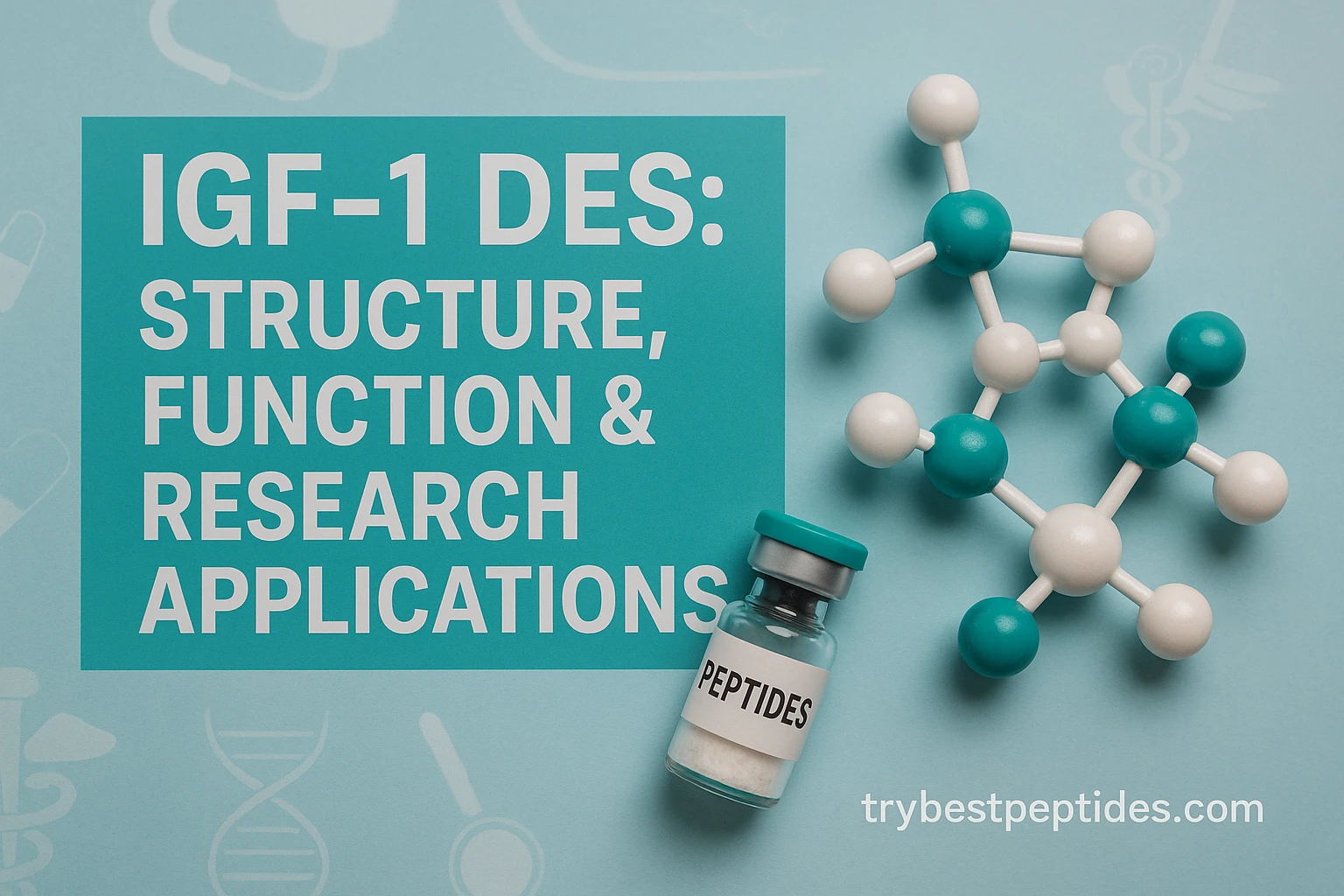
IGF-1 DES, scientifically known as Des(1-3)IGF-1, represents a fascinating naturally occurring variant of insulin-like growth factor-1 that has become increasingly relevant in peptide research circles. This truncated form differs significantly from its parent compound, offering distinct pharmacological properties that have attracted considerable scientific attention. Unlike the full-length IGF-1 molecule, IGF-1 DES lacks the first three amino acids, a modification that fundamentally alters how it interacts with cellular receptors and binding proteins. Researchers have identified unique characteristics that distinguish it from other IGF-1 variants, particularly regarding receptor affinity and biological activity. Understanding the mechanics behind this peptide variant is essential for anyone engaged in serious peptide research or seeking to comprehend the broader landscape of growth factor analogues.
What Is IGF-1 DES?
IGF-1 DES is a truncated peptide variant created through the removal of the first three amino acids from the N-terminus of the insulin-like growth factor-1 molecule. This structural modification produces a compound that maintains many of the biological properties associated with IGF-1 while demonstrating enhanced receptor selectivity.
The discovery of IGF-1 DES revealed that the first three amino acids, while part of the complete IGF-1 structure, were not essential for core biological activity. In fact, their removal appears to enhance certain aspects of the peptide's function. This naturally occurring variant exists in physiological systems and has been isolated in various tissues, suggesting it plays a role in endogenous metabolic processes.
As a research peptide, IGF-1 DES has gained attention because it offers researchers an alternative model for studying growth factor signaling pathways without the full complexity of intact IGF-1. Its truncated structure makes it valuable for investigating which regions of the IGF-1 molecule are truly critical for specific biological outcomes.
Molecular Structure and Properties
The molecular distinction of IGF-1 DES centers on the absence of three amino acids at the N-terminus, specifically the first three residues (hence the designation "Des(1-3)"). This seemingly minor structural change produces measurable differences in how the peptide behaves at the molecular level.
Structural Characteristics
IGF-1 DES retains the core structural elements that define IGF-1 peptides, including the characteristic disulfide bonds and three-dimensional folding patterns. However, the truncation affects the overall charge distribution and surface properties of the molecule. This results in altered interactions with insulin-like growth factor binding proteins (IGFBPs), which play crucial roles in regulating IGF availability and activity in physiological systems.
The peptide's molecular weight is slightly reduced compared to full-length IGF-1 due to the removal of three amino acid residues. Despite this minimal change in mass, the structural modification produces notable functional consequences that have been well-documented in research literature.
Binding Characteristics
One significant property of IGF-1 DES is its reduced affinity for binding proteins. While full-length IGF-1 binds tightly to IGFBPs, the truncated variant demonstrates weaker interactions with these regulatory proteins. This characteristic has important implications for bioavailability and cellular uptake, as reduced IGFBP binding potentially allows for more direct access to IGF-1 receptors on target cells.
Mechanisms of Action
IGF-1 DES operates through mechanisms fundamentally similar to other IGF-1 variants, primarily through interaction with the type 1 IGF receptor (IGF-1R). However, the structural differences create distinct patterns of activity that distinguish it from full-length IGF-1 and other modified variants.
Receptor Interaction
The peptide binds to IGF-1 receptors located on cell surfaces, initiating intracellular signaling cascades associated with growth, proliferation, and metabolic processes. The truncation appears to influence the specificity and efficiency of this binding, though research indicates the peptide maintains functional IGF-1R activation despite its modified structure.
Studies suggest that IGF-1 DES may have reduced affinity for the insulin receptor compared to full-length IGF-1, potentially providing more selective signaling through IGF-1R pathways. This selectivity could be advantageous for research applications where distinguishing IGF-1R-specific effects from insulin receptor interactions is important.
Downstream Signaling
Once IGF-1 DES binds to IGF-1R, it triggers well-characterized intracellular signaling pathways including the PI3K/Akt pathway and the MAPK/ERK pathway. These cascade mechanisms regulate protein synthesis, cell survival, and metabolic functions. The truncated structure does not appear to substantially impair activation of these pathways, though subtle differences in the kinetics or magnitude of signaling may occur compared to full-length IGF-1.
Research Applications
IGF-1 DES has found application in numerous research contexts where scientists need a simplified IGF-1 model or require the specific properties offered by the truncated variant.
Muscle tissue studies represent one significant research area where IGF-1 DES has been employed. The peptide's properties make it useful for investigating growth factor effects on myocyte differentiation and protein synthesis in controlled research environments.
Metabolic research benefits from IGF-1 DES because its reduced IGFBP binding creates clearer experimental conditions for studying direct receptor-mediated metabolic effects without confounding variables introduced by binding protein interactions.
Comparative studies frequently utilize IGF-1 DES alongside other IGF variants to understand how specific structural elements influence biological activity. This comparative approach has contributed significantly to understanding IGF-1 structure-function relationships.
IGF-1 DES vs IGF-1 LR3: A Comparison
Both IGF-1 DES and IGF-1 LR3 represent modified variants of insulin-like growth factor-1, but they differ substantially in structure and properties.
IGF-1 LR3 incorporates additional amino acid sequences at the N-terminus, extending the molecule with an arginine residue and other modifications that enhance IGFBP resistance. This makes IGF-1 LR3 highly resistant to binding protein inactivation and potentially longer-lasting in biological systems.
IGF-1 DES, conversely, represents a truncation rather than an extension. It has reduced IGFBP binding, which works in the opposite direction—rather than resisting binding protein sequestration, it simply doesn't bind as tightly to these regulatory proteins in the first place.
The pharmacokinetic profiles differ accordingly. IGF-1 LR3 tends to have an extended half-life due to IGFBP resistance, while IGF-1 DES may have a shorter effective duration because it's more susceptible to binding protein interactions or clearance mechanisms. For researchers, this means IGF-1 DES may offer advantages when studying acute effects or conducting short-term experiments, while IGF-1 LR3 might be preferable for investigations requiring sustained peptide presence.
Safety and Side Effects
As a research peptide, IGF-1 DES has not undergone extensive human clinical trials, and safety information derives primarily from in vitro and animal research models. Researchers working with this peptide must understand potential considerations related to growth factor administration.
Growth factors generally carry theoretical risks associated with uncontrolled cell proliferation, though the degree to which these concerns apply to IGF-1 DES specifically remains an active research question. The reduced IGFBP binding might theoretically create different safety profiles compared to full-length IGF-1, though definitive comparative data is limited.
Hypoglycemia represents a potential consideration with IGF-1 variants, as insulin-like growth factors can affect glucose metabolism. The selectivity of IGF-1 DES for IGF-1 receptors over insulin receptors might mitigate this concern compared to full-length IGF-1, but this remains an area requiring further investigation.
Regulatory and Legal Status
The regulatory classification of IGF-1 DES varies significantly by jurisdiction and application. As a research peptide, it typically falls outside the approved pharmaceutical category in most countries, meaning it is not approved for human therapeutic use.
In research contexts, peptide use is governed by institutional review boards and research facility regulations. Scientists conducting legitimate research must maintain appropriate documentation, facility standards, and compliance with local regulations governing research peptide handling.
Non-research, non-medical applications of IGF-1 DES remain legally restricted in most jurisdictions. Individuals should verify applicable regulations in their specific locations before acquiring or using this or any research peptide.
Key Takeaways
- IGF-1 DES is a naturally occurring truncated variant of IGF-1 created by removing the first three amino acids from the parent molecule
- The structural modification reduces IGFBP binding, allowing more direct receptor access compared to full-length IGF-1
- Receptor selectivity appears enhanced for IGF-1R over insulin receptors, offering research advantages for pathway-specific investigations
- Unlike IGF-1 LR3, which extends the molecule and resists binding proteins, IGF-1 DES achieves reduced binding through truncation
- Research applications span muscle tissue studies, metabolic research, and comparative peptide investigations
- Regulatory status restricts use to legitimate research environments with appropriate institutional oversight
- As a research peptide, comprehensive safety data in humans remains limited, emphasizing the importance of following institutional guidelines