Glycylglycine stands as one of the most fundamental compounds in peptide chemistry, representing the simplest possible dipeptide structure composed of two glycine amino acids linked through a peptide bond. This elegant molecular arrangement has captured the attention of biochemists and researchers worldwide, offering unique properties that extend far beyond its diminutive size. Whether you're exploring peptide science for academic purposes, research applications, or understanding basic biochemistry, glycylglycine serves as an excellent entry point into the complex world of peptide structures. In this comprehensive guide, we'll examine the structural characteristics, biochemical significance, and practical applications of this remarkable compound that continues to influence modern scientific research and pharmaceutical development.
Understanding Dipeptides and Their Significance
Dipeptides represent the most basic form of peptide chains, consisting of exactly two amino acids connected via a peptide bond. These molecular structures occupy a unique position in biochemistry, serving as the fundamental building blocks for understanding larger, more complex protein structures. Unlike single amino acids, dipeptides exhibit altered chemical properties and biological activities that arise from their combined composition.
Glycylglycine specifically demonstrates how simplicity can yield remarkable scientific value. Each glycine residue contributes a single hydrogen atom as its side chain, making this dipeptide the most uncomplicated peptide structure possible. This minimal configuration eliminates steric hindrances and complications, allowing researchers to study peptide chemistry in its purest form.
The significance of dipeptides extends beyond theoretical chemistry. Many biological processes rely on dipeptide recognition, transport, and metabolism. Understanding dipeptide chemistry provides essential insights into protein synthesis, enzyme function, and cellular signaling mechanisms that govern living organisms.
Chemical Structure and Molecular Composition
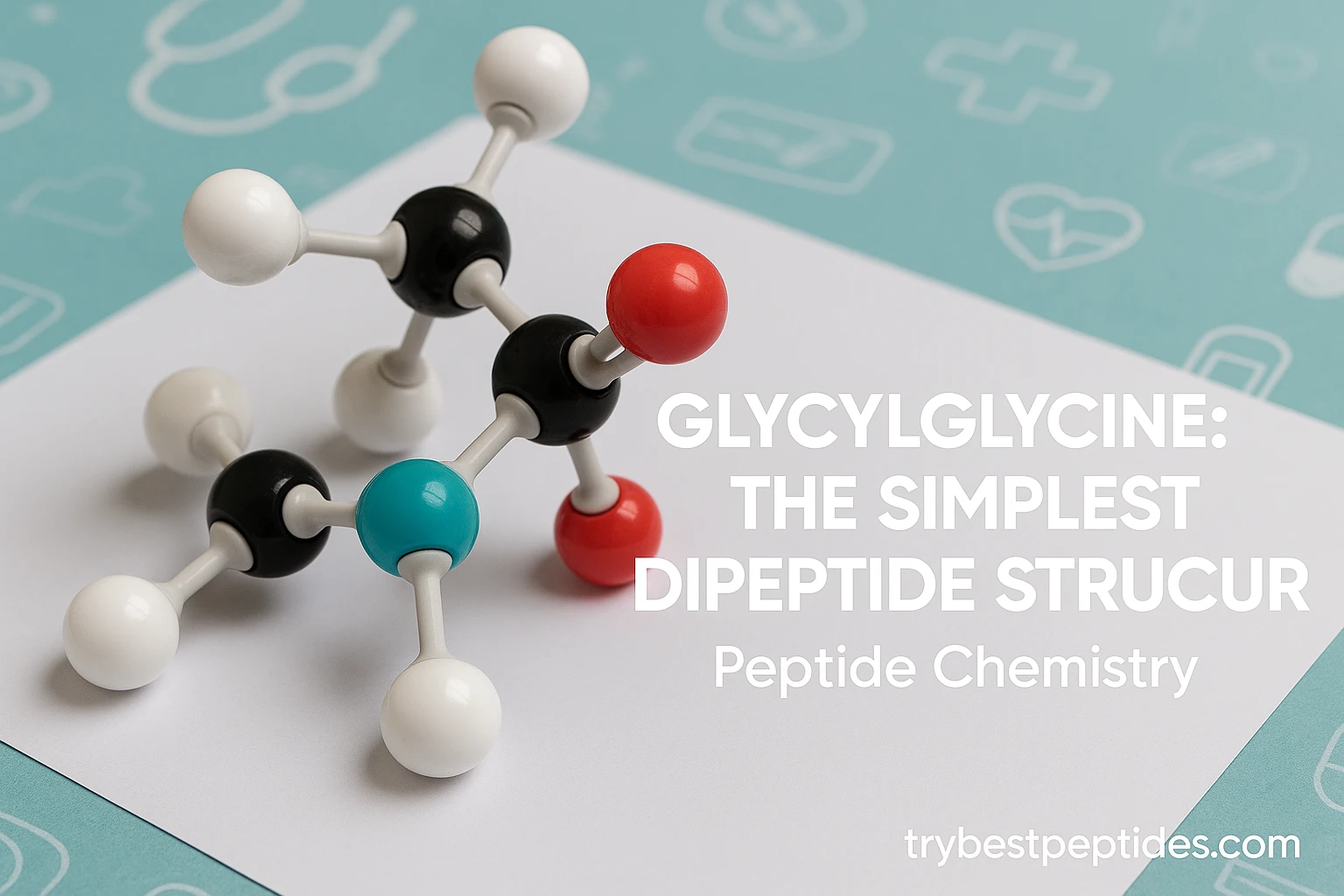
Glycylglycine exhibits a straightforward molecular formula: C₅H₁₀N₂O₃. This composition reflects two glycine units joined through a peptide bond, which forms between the carboxyl group of one amino acid and the amino group of another.
The structural arrangement includes:
- N-terminus: The free amino group at the beginning of the chain
- C-terminus: The free carboxyl group at the end of the chain
- Peptide bond: The covalent bond linking the two glycine residues
- Central alpha carbons: Two carbon atoms bearing the amino and carboxyl groups respectively
The molecular weight of glycylglycine reaches approximately 132.12 g/mol, making it remarkably lightweight compared to larger peptides. This low molecular weight contributes to its excellent solubility properties and ease of transport across biological membranes in certain contexts.
What distinguishes glycylglycine from other dipeptides is the absence of bulky side chains. The hydrogen atoms attached to each alpha carbon minimize spatial constraints, creating a highly flexible molecule capable of adopting various conformations. This flexibility proves invaluable for studying peptide behavior without the confounding effects of complex side-chain interactions.
Biochemical Properties and Characteristics
The biochemical profile of glycylglycine reveals properties that make it uniquely valuable for research and applications. Its solubility in aqueous solutions exceeds that of many other peptides, facilitating use in biological systems and laboratory settings. This characteristic enables researchers to achieve high concentrations without precipitation or crystallization issues.
Glycylglycine demonstrates remarkable stability across different pH ranges, though like all peptides, it remains susceptible to proteolytic enzymes that specifically recognize and cleave peptide bonds. Its pKa values allow for manipulation of charge state depending on experimental conditions, providing researchers with fine control over molecular behavior.
The compound exhibits minimal immunogenicity, meaning it provokes little to no immune response when introduced into biological systems. This property holds significant importance for researchers developing therapeutic applications, as it reduces the likelihood of unwanted inflammatory responses or allergic reactions.
Additionally, glycylglycine participates in various enzymatic processes. Peptidases and other proteolytic enzymes utilize this simple dipeptide as a model substrate for studying enzyme kinetics and mechanism. Its straightforward structure allows researchers to isolate variables and understand fundamental enzymatic principles without complication.
Applications in Scientific Research
The applications of glycylglycine extend across multiple scientific disciplines, each leveraging its unique properties for specific purposes.
Biochemical Research and Education
Glycylglycine serves as an ideal teaching tool for biochemistry education. Its simple structure allows students to comprehend peptide bonding, amino acid linkages, and basic protein chemistry without overwhelming complexity. Many laboratory courses employ glycylglycine for demonstrating peptide synthesis techniques and characterization methods.
Enzyme Studies and Kinetics
Researchers frequently use glycylglycine as a substrate in enzyme kinetics experiments. Peptidases and proteolytic enzymes are studied using this dipeptide to determine Km values, Vmax parameters, and reaction mechanisms. The simplicity of the substrate ensures that observed enzyme behavior reflects true catalytic properties rather than substrate-specific complications.
Pharmaceutical Development
In pharmaceutical research, glycylglycine appears in formulations and studies investigating peptide drug delivery. Its stability and low immunogenicity make it valuable for developing peptide-based therapeutics and understanding how peptide drugs behave in biological systems.
Nutritional and Cosmetic Applications
Some nutritional supplements incorporate glycylglycine for its potential bioavailability advantages over free amino acids. The dipeptide form may offer superior absorption characteristics in certain tissue contexts. Similarly, cosmetic formulations occasionally include glycylglycine for its skin compatibility and stability properties.
Industrial Biotechnology
Industrial applications include using glycylglycine in fermentation studies, as a buffer component, and in protein production optimization. Its characteristics make it suitable for quality control processes and analytical standards in biotechnology settings.
Metabolic Pathways and Biological Function
When glycylglycine enters biological systems, it undergoes specific metabolic processes. Intestinal peptidases recognize and hydrolyze the peptide bond, releasing two glycine molecules that the body can utilize for various synthetic pathways.
Glycine itself serves multiple critical functions: collagen synthesis, creatine production, glutathione formation, and neurotransmitter metabolism. By studying glycylglycine metabolism, researchers gain insights into how the body processes dietary peptides and maintains amino acid homeostasis.
The compound also demonstrates potential roles in cellular signaling and immune modulation, though these mechanisms require further investigation. Some evidence suggests that certain dipeptides influence immune cell function and inflammatory responses, suggesting glycylglycine may participate in immunoregulatory processes.
Advantages Over Alternative Compounds
Compared to free glycine amino acids, glycylglycine offers distinct advantages in specific contexts. The dipeptide form exhibits improved bioavailability in certain conditions, potentially allowing more efficient utilization by tissues. Its peptide nature may trigger different absorption mechanisms than free amino acids, resulting in superior delivery characteristics.
When compared to larger peptides and proteins, glycylglycine's simplicity eliminates the complications of tertiary and quaternary structures, post-translational modifications, and complex folding requirements. This makes it an ideal model system for fundamental research that larger molecules would confound.
Production and Synthesis Methods
Glycylglycine synthesis typically employs standard peptide chemistry techniques. Chemical synthesis methods involve protecting the reactive amino groups, activating the carboxyl group, and facilitating peptide bond formation under controlled conditions. Following synthesis, purification steps ensure product homogeneity and characterization confirms molecular identity.
Commercial production maintains strict quality standards to ensure purity exceeding 95% for research-grade material. Analytical techniques including mass spectrometry, nuclear magnetic resonance spectroscopy, and high-performance liquid chromatography verify product specifications and detect contaminants.
Safety Considerations and Handling
Glycylglycine generally exhibits low toxicity, and standard laboratory safety protocols apply to its handling. As a naturally occurring compound related to amino acids found in all living organisms, it presents minimal hazard for properly trained personnel working in appropriate facilities.
Proper storage conditions maintain stability and prevent degradation. Most manufacturers recommend storage at room temperature or refrigerated conditions, away from direct sunlight and moisture. Properly stored glycylglycine maintains stability for extended periods, allowing for long-term inventory management without concern for decomposition.
Future Perspectives and Emerging Research
Ongoing research continues exploring novel applications for glycylglycine. Scientists investigate its potential roles in cellular signaling, immunological functions, and therapeutic applications for various disease states. Advanced analytical techniques enable researchers to understand glycylglycine interactions at the molecular level with unprecedented precision.
Emerging biotechnology applications may incorporate glycylglycine into novel therapeutic delivery systems, combining its favorable properties with advanced formulation technologies. As peptide-based therapeutics gain prominence in pharmaceutical development, fundamental compounds like glycylglycine provide valuable insights for designing next-generation treatments.
Conclusion
Glycylglycine exemplifies how the simplest compounds often provide the greatest scientific value. Its straightforward structure, combined with remarkable biochemical properties, makes it indispensable for researchers across multiple disciplines. From fundamental biochemistry education to advanced pharmaceutical research, this elegant dipeptide continues demonstrating relevance and utility.
The compound's unique characteristics—minimal complexity, excellent solubility, stability, and low immunogenicity—position it as an ideal research tool and potential therapeutic agent. As scientific understanding advances and new applications emerge, glycylglycine remains a cornerstone of peptide chemistry and biochemical research.
Whether you're a researcher, student, or industry professional, understanding glycylglycine provides essential foundational knowledge for working with peptides and comprehending the biochemical principles that govern life itself.
Key Takeaways
- Simplest Structure: Glycylglycine represents the most basic dipeptide, consisting of two glycine amino acids linked by a single peptide bond
- Molecular Composition: With the formula C₅H₁₀N₂O₃ and molecular weight of 132.12 g/mol, glycylglycine is remarkably lightweight and highly soluble
- Research Applications: Widely used in biochemical research, enzyme kinetics studies, pharmaceutical development, and educational settings
- Biochemical Advantages: Demonstrates superior solubility, stability across pH ranges, and minimal immunogenicity
- Metabolic Significance: Serves as a model compound for understanding peptide metabolism and amino acid utilization in biological systems
- Therapeutic Potential: Shows promise in pharmaceutical development, nutritional applications, and cosmetic formulations
- Production Quality: Commercial synthesis maintains high purity standards using established peptide chemistry techniques
-