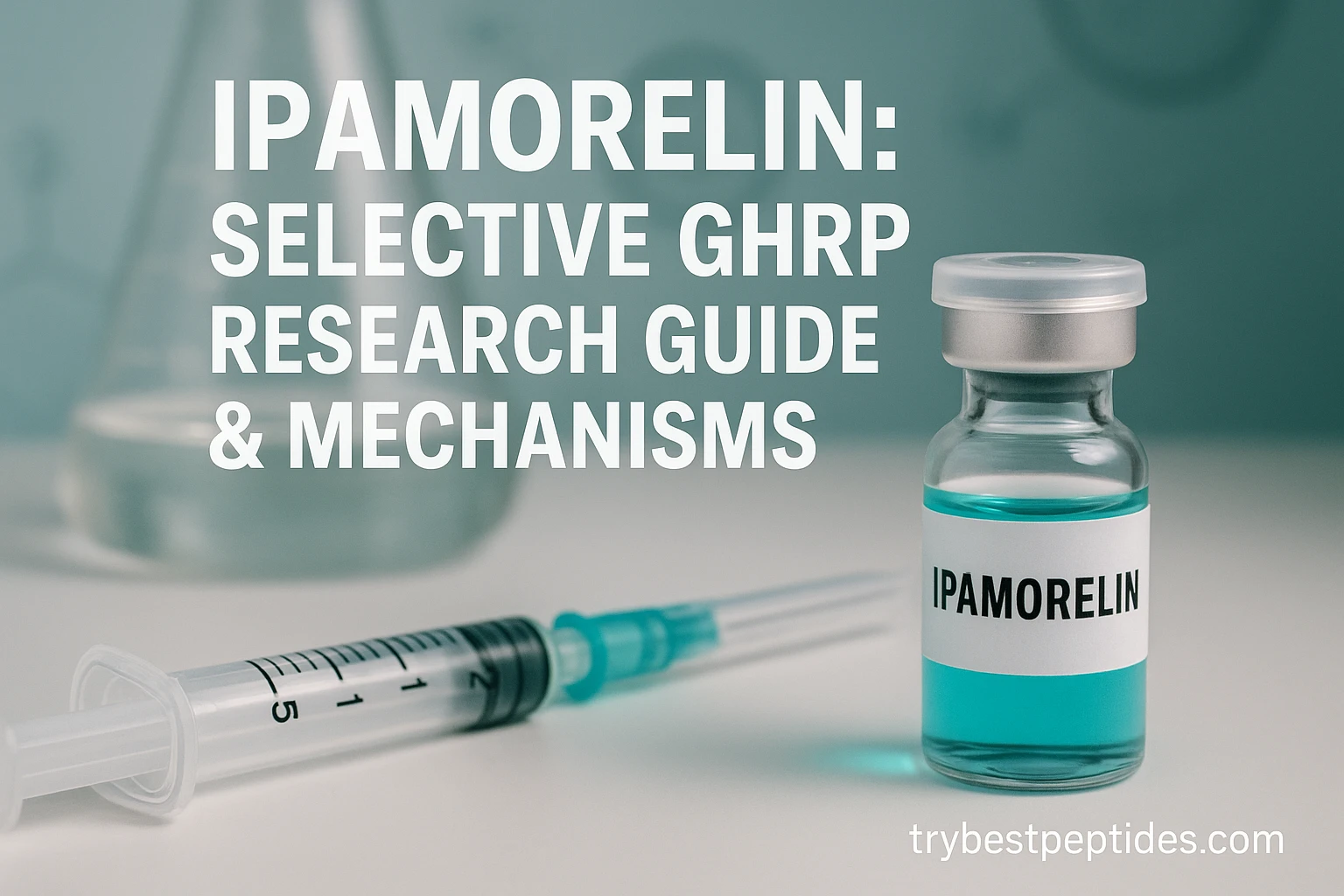
Growth hormone releasing peptides (GHRPs) have emerged as one of the most researched areas in peptide science over the past three decades. These compounds work by stimulating the body's natural growth hormone production—a process fundamentally different from direct hormone replacement. However, early GHRP compounds presented a significant challenge: they triggered unwanted releases of cortisol and prolactin alongside growth hormone, limiting their practical application in research settings. Ipamorelin represents a breakthrough in this field as a selective GHRP that maintains the growth hormone-stimulating benefits while minimizing these problematic secondary effects. This comprehensive guide explores ipamorelin's mechanisms, research evidence, pharmacokinetics, and current regulatory status, providing researchers with an evidence-based foundation for understanding this peptide's role in modern hormone research.
What Is Ipamorelin?
Ipamorelin is a selective growth hormone releasing peptide (GHRP) that belongs to the family of ghrelin receptor agonists. Classified as a pentapeptide due to its five-amino-acid structure, ipamorelin was specifically engineered to address limitations found in earlier GHRP compounds.
Unlike its predecessors—including GHRP-6 and GHRP-2—ipamorelin demonstrates remarkable selectivity for growth hormone release. This selectivity is what distinguishes it in the peptide research landscape. While conventional GHRPs trigger cortisol and prolactin elevation as secondary effects, ipamorelin achieves growth hormone stimulation without these additional hormonal cascades.
The peptide operates as a synthetic mimetic of ghrelin, the natural hunger hormone that also plays a crucial role in growth hormone secretion. This mechanism allows researchers to study growth hormone dynamics using a compound that more closely mirrors the body's natural physiological processes.
How Ipamorelin Works: Mechanisms of Action
Understanding ipamorelin's functionality requires examining how it interacts with the body's endocrine system at the molecular level.
Ghrelin Receptor Activation
Ipamorelin binds to the growth hormone secretagogue receptor (GHS-R1a), the same receptor that ghrelin naturally targets. This receptor is abundantly expressed in the hypothalamus and pituitary gland—key centers for hormone regulation. When ipamorelin binds to GHS-R1a, it initiates a cascade of cellular signals that stimulate growth hormone secretion from somatotroph cells in the anterior pituitary.
Selective Growth Hormone Stimulation
The critical distinction between ipamorelin and earlier GHRPs lies in its selectivity profile. Earlier compounds like GHRP-6 activated multiple neuroendocrine pathways simultaneously, causing cortisol and prolactin release. Ipamorelin's structure specifically targets growth hormone pathways while demonstrating minimal activity on other hormonal axes.
Research suggests this selectivity stems from ipamorelin's particular molecular configuration and binding characteristics. Its interaction with GHS-R1a appears to preferentially activate growth hormone-releasing neurons while bypassing secondary pathways that would otherwise trigger cortisol and prolactin elevation.
Preservation of Natural Pulsatility
Unlike direct growth hormone replacement, ipamorelin maintains the body's natural pulsatile secretion pattern. This characteristic preserves the physiological rhythm of growth hormone release, which carries important metabolic implications and more closely mirrors endogenous patterns studied in basic hormone research.
Pharmacokinetics and Dosing
Effective research application requires understanding how ipamorelin behaves within the body.
Absorption and Distribution
Ipamorelin exhibits rapid absorption following administration, with peak plasma concentrations typically achieved within 15-30 minutes. Its relatively short half-life of approximately 2 hours makes it suitable for acute research protocols examining acute growth hormone response patterns.
The peptide's small pentapeptide structure allows for efficient distribution across physiological compartments, with notable CNS penetration through its action on hypothalamic receptors. This pharmacokinetic profile supports its mechanism of action as a central hormone regulator.
Typical Research Dosing
Research protocols typically employ ipamorelin doses ranging from 200 to 300 micrograms per administration, administered via subcutaneous or intravenous injection. Dosing varies based on study design, research objectives, and individual subject characteristics.
Administration timing proves important in research contexts. Many protocols utilize evening dosing to leverage ipamorelin's growth hormone-stimulating effects alongside the body's natural nocturnal growth hormone peak, though research applications vary considerably.
Research Evidence and Efficacy
Scientific literature examining ipamorelin has accumulated substantial evidence regarding its growth hormone-stimulating capabilities.
Growth Hormone Elevation
Multiple research studies demonstrate ipamorelin's consistent ability to elevate growth hormone levels. Peak GH responses typically occur 30-60 minutes following administration, with magnitude dependent on various factors including age, metabolic status, and baseline growth hormone secretory capacity.
Studies comparing ipamorelin to earlier GHRPs have documented comparable or superior growth hormone responses, with the added advantage of reduced cortisol and prolactin side effects. This profile makes ipamorelin particularly valuable for research applications requiring sustained hormone studies without endocrine complications.
Metabolic Effects in Research Models
Beyond growth hormone stimulation, research has explored ipamorelin's metabolic effects. Studies in animal models and human research subjects suggest potential impacts on lipid metabolism, insulin sensitivity, and body composition—effects consistent with growth hormone's known metabolic roles.
However, researchers should note that many of these studies remain preliminary, and the clinical significance of observed metabolic changes continues investigation.
Ipamorelin and CJC-1295: The Synergistic Combination
A particularly important research application involves combining ipamorelin with CJC-1295, a growth hormone-releasing hormone (GHRH) analog.
Complementary Mechanisms
Ipamorelin stimulates growth hormone release through ghrelin receptor activation, while CJC-1295 works through GHRH pathways—fundamentally different but complementary mechanisms. This dual-pathway approach theoretically produces synergistic growth hormone stimulation, leveraging both major physiological systems governing growth hormone secretion.
Research Applications
The ipamorelin-CJC-1295 combination has become increasingly popular in peptide research protocols studying maximal growth hormone response capacity and pituitary function. The combination allows researchers to assess how simultaneous activation of both major growth hormone-releasing pathways affects hormone dynamics.
Safety Profile and Side Effects
Comprehensive safety assessment remains essential for research applications.
Adverse Effects Profile
Ipamorelin generally demonstrates a favorable safety profile compared to earlier GHRPs. The absence of cortisol elevation represents a significant advantage, as cortisol-mediated effects include immune suppression and metabolic complications that complicate interpretation of research results.
Reported side effects remain minimal in most research contexts, with occasional reports of mild injection site reactions or transient facial flushing. These effects typically prove mild and self-limiting.
Important Considerations
Researchers must acknowledge that ipamorelin remains a research compound with limited long-term safety data in human populations. All applications should occur within appropriate research and regulatory frameworks. Individuals with pituitary or hypothalamic disorders, active malignancies, or acute illness should be excluded from research protocols.
Legal and Regulatory Status
Understanding ipamorelin's legal standing proves critical for appropriate application.
Research Classification
In most jurisdictions, ipamorelin remains classified as a research peptide intended exclusively for laboratory investigation. It is not approved for clinical use by major regulatory bodies including the FDA in the United States or equivalent authorities in other countries.
Supply and Legality
Ipamorelin's legality varies by jurisdiction and intended use. In most regions, research-grade ipamorelin can be legally obtained from licensed research suppliers for legitimate laboratory applications. However, restrictions apply regarding human use, and procurement should always occur through established research channels with appropriate documentation.
Researchers must verify local regulations before procurement and ensure compliance with institutional review board requirements and relevant legislation.
Frequently Asked Questions
How does ipamorelin differ from GHRP-6 and GHRP-2?
The primary distinction lies in selectivity. While GHRP-6 and GHRP-2 stimulate growth hormone alongside cortisol and prolactin elevation, ipamorelin maintains GH stimulation with minimal impact on these secondary hormones.
Can ipamorelin be used for anti-aging applications?
While growth hormone's role in aging remains researched, ipamorelin's application for anti-aging purposes remains speculative and largely unvalidated by rigorous clinical evidence.
What is the typical timeframe for observing growth hormone responses?
Peak growth hormone elevation typically occurs 30-60 minutes following ipamorelin administration, with effects remaining elevated for 2-3 hours in most research contexts.
Is ipamorelin suitable for long-term research protocols?
The limited long-term safety data suggests careful consideration for extended-duration research. Most established protocols employ ipamorelin for acute or short-term research applications.
The Bottom Line
Ipamorelin represents a significant advancement in growth hormone research tools, offering selective growth hormone stimulation without the endocrine complications associated with earlier GHRP compounds. Its mechanism through ghrelin receptor activation, combined with its favorable selectivity profile, makes it valuable for research examining growth hormone dynamics and pituitary function.
However, researchers must recognize ipamorelin's experimental status and ensure all applications comply with institutional, regulatory, and ethical requirements. The peptide's greatest utility emerges in controlled research settings where its selective GH-stimulating properties can be systematically evaluated without the confounding effects of unwanted hormonal changes.
As peptide research continues advancing, ipamorelin will likely remain an important tool for understanding growth hormone physiology and exploring potential therapeutic applications, provided research continues within appropriate scientific and regulatory frameworks.
Key Takeaways
- Selective Action: Ipamorelin uniquely stimulates growth hormone without triggering cortisol or prolactin elevation, unlike earlier GHRP compounds
- Mechanism: Functions as a ghrelin receptor agonist, mimicking natural growth hormone regulation through GHS-R1a receptor activation
- Pharmacokinetics: Features rapid absorption, peak effects within 30-60 minutes, and approximately 2-hour half-life
- Research Applications: Particularly valuable in protocols examining acute GH response and pituitary function, often combined with CJC-1295
- Safety Profile: Demonstrates favorable safety compared to earlier GHRPs with minimal documented adverse effects
- Regulatory Status: Remains classified as a research compound; not approved for human clinical use in major jurisdictions
- Future Potential: Continues serving as an important research tool for growth hormone physiology investigation
-