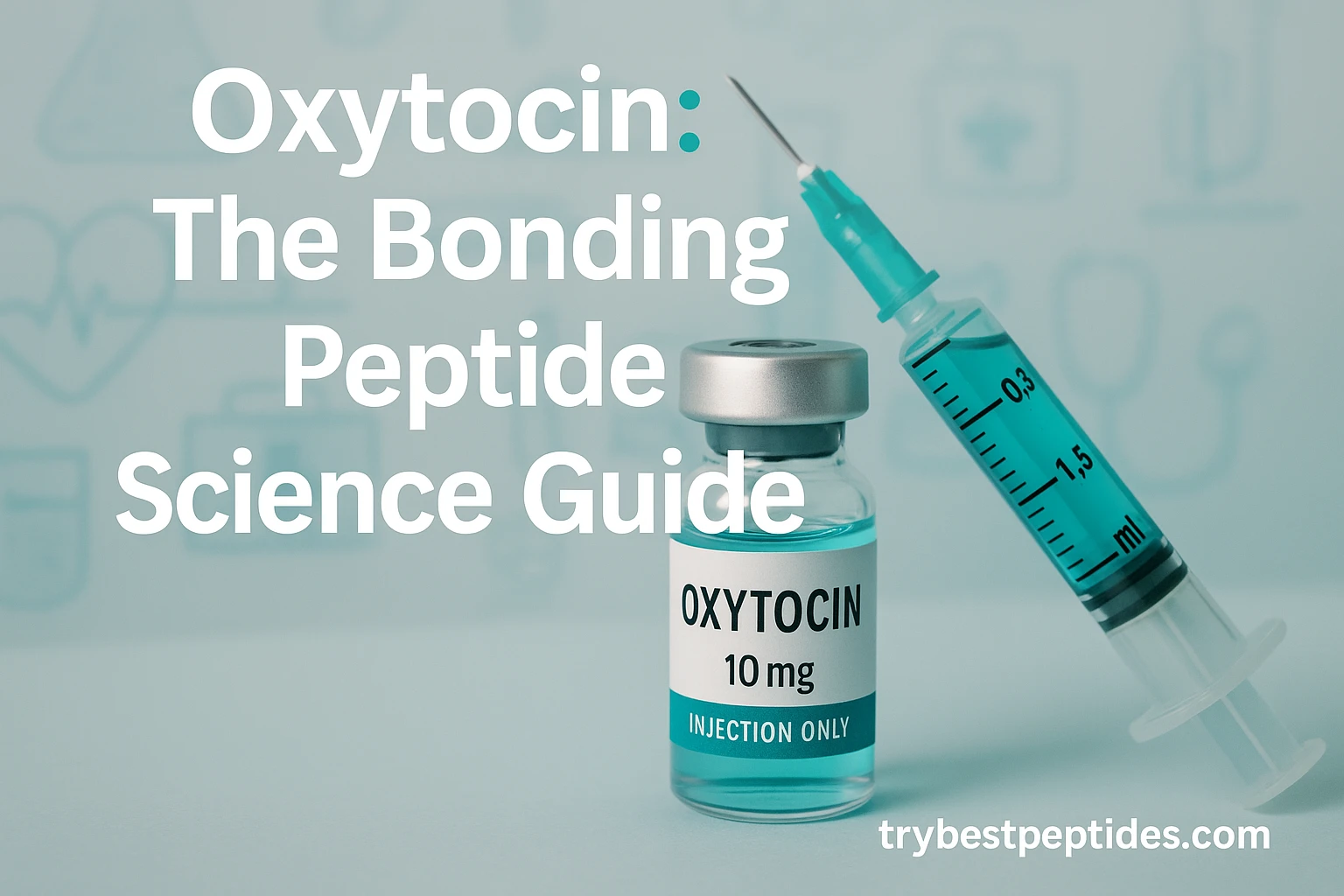
For decades, oxytocin has captured the public imagination as the ultimate "love hormone"—a magical molecule responsible for cuddles, trust, and human connection. While popular media has simplified oxytocin into a feel-good narrative, the scientific reality is far more complex and nuanced. This comprehensive guide explores what oxytocin actually is, how it functions within the body, its legitimate clinical applications, and the gap between marketing claims and peer-reviewed evidence. Whether you're interested in peptide biology, neuroscience, or understanding the mechanisms behind human bonding, this exploration moves beyond oversimplification to reveal the sophisticated roles oxytocin plays in physiology and behavior.
What Is Oxytocin?
Oxytocin is a nine-amino acid neuropeptide synthesized primarily in the hypothalamus, a small but crucial region at the base of the brain. The posterior pituitary gland stores and releases oxytocin into the bloodstream, allowing it to function both as a hormone and a neurotransmitter. This dual role makes oxytocin unique—it operates within the central nervous system to influence brain activity while also circulating systemically to affect various organs and tissues.
The peptide's molecular structure, consisting of a cyclic arrangement of amino acids linked by a disulfide bond, enables its specific binding to oxytocin receptors found throughout the nervous system and peripheral tissues. These receptors are distributed in the brain regions associated with emotion, social cognition, and reward processing, as well as in organs like the uterus, mammary glands, and heart.
Understanding oxytocin requires recognizing that no single molecule controls complex human behaviors. Instead, oxytocin functions as one component within intricate neurobiological networks involving dopamine, serotonin, cortisol, and numerous other signaling molecules. This interdependence explains why the "love hormone" narrative, while memorable, fails to capture oxytocin's actual functional scope.
How Oxytocin Works: Mechanisms of Action
Oxytocin exerts its effects by binding to oxytocin receptors, triggering intracellular signaling cascades that ultimately influence neural activity and hormone release. The receptor density varies significantly across brain regions and between individuals, partly explaining why oxytocin produces different effects in different people under similar circumstances.
Neurobiological Pathways
In the brain, oxytocin modulates activity in regions involved in social processing, including the amygdala, anterior cingulate cortex, and striatum. Animal studies and human neuroimaging research demonstrate that oxytocin can reduce amygdala reactivity to threatening stimuli, potentially lowering fear and anxiety. Simultaneously, oxytocin enhances activity in reward-related brain regions, creating positive associations with social interactions.
However, this isn't universally straightforward. Research shows oxytocin can also increase in-group favoritism while promoting suspicion toward out-groups—a phenomenon termed "parochial altruism." This suggests oxytocin's social effects depend heavily on context, prior relationships, and individual differences in receptor expression.
Physiological Functions Beyond Bonding
Beyond social behavior, oxytocin plays essential roles in reproduction and lactation. During labor, oxytocin stimulates uterine contractions, making it instrumental in childbirth. After delivery, nursing triggers oxytocin release, which facilitates milk letdown and supports maternal-infant bonding through repeated sensory stimulation.
These reproductive functions highlight an important distinction: oxytocin's most established roles involve physical rather than purely emotional processes. The "bonding" oxytocin facilitates during labor and lactation occurs through biological necessity, not through rewiring social preferences.
FDA-Approved Clinical Uses
Oxytocin's clinical applications remain surprisingly limited despite decades of research and widespread interest. The FDA has approved oxytocin (marketed as Pitocin) for two specific indications: labor induction and the control of postpartum hemorrhage. These approvals reflect oxytocin's direct physical effects on smooth muscle, not its social or emotional properties.
In obstetrics, oxytocin remains the standard treatment for augmenting contractions during prolonged labor and for managing excessive postpartum bleeding by causing uterine muscle contraction. These therapeutic uses are well-established, evidence-based, and distinct from the behavioral or psychological claims frequently encountered in popular discourse.
The absence of FDA approval for psychiatric or behavioral conditions—despite oxytocin's prominent role in social neuroscience—speaks volumes about the current evidence base. While research exploring oxytocin's potential in autism spectrum disorder, social anxiety, and other conditions continues, no interventions using oxytocin for these purposes have achieved regulatory approval, indicating insufficient evidence of efficacy or unresolved safety questions.
Research Applications and Emerging Interest
The scientific community continues investigating oxytocin's potential applications across multiple fields, though findings often reveal complexity rather than straightforward therapeutic pathways.
Autism Spectrum Disorder Research
Several preliminary studies have examined whether intranasal oxytocin might improve social reciprocity in individuals with autism. Results have been mixed, with some studies showing modest improvements in specific social tasks while others found minimal effects. The heterogeneity of autism itself—manifesting differently across individuals—likely contributes to variable responses to oxytocin administration.
Anxiety and Stress Response
Research into oxytocin's anxiolytic potential has generated promising preclinical data in animal models. However, translating these findings to human clinical practice has proven challenging. Some studies suggest oxytocin reduces physiological stress markers, while others show context-dependent effects where oxytocin's influence depends on whether individuals perceive social situations as supportive or threatening.
Social Cognition Studies
Neuroscience research consistently demonstrates that oxytocin influences how people perceive, interpret, and respond to social information. These studies have advanced our understanding of social processing mechanisms but haven't necessarily identified therapeutic applications ready for clinical translation.
The Nuanced Picture: Beyond the "Love Hormone"
The gap between scientific understanding and public perception regarding oxytocin deserves careful examination. Media narratives have reduced this complex peptide to a simple cause-and-effect molecule: more oxytocin equals more trust, empathy, and love.
Reality presents a more sophisticated picture. Oxytocin's effects depend on numerous moderating factors including:
- Individual receptor density and genetic variation in oxytocin receptor genes
- Social context and whether individuals perceive situations as safe or threatening
- Relationship history and attachment patterns
- Concurrent hormone levels including cortisol, testosterone, and estrogen
- Cultural background and learned social expectations
- Timing and dosage of administration in research settings
Furthermore, oxytocin's effects aren't universally prosocial. In certain contexts, oxytocin increases defensive aggression, enhances in-group bias at the expense of out-group cooperation, and can even amplify negative social behaviors when individuals harbor hostile intentions toward others.
Intranasal Delivery and Research Methodology Considerations
Most human oxytocin research employs intranasal administration—a delivery method with notable limitations that researchers increasingly acknowledge. The blood-brain barrier presents a formidable challenge; oxytocin administered intranasally may reach the brain through direct nose-to-brain pathways, but the amount actually crossing the barrier versus remaining in circulation remains poorly quantified.
Furthermore, intranasal oxytocin studies typically involve single administrations in controlled laboratory settings, providing limited insight into how chronic oxytocin exposure might influence neural function or behavior. Sample sizes in many studies remain relatively small, and effect sizes, while statistically significant, often prove clinically modest.
These methodological considerations don't invalidate oxytocin research but rather highlight the importance of interpreting findings appropriately and acknowledging the distance between preliminary findings and clinical applications.
Safety Profile and Regulatory Status
Acute oxytocin administration appears relatively safe with minimal adverse effects reported in most studies. However, this doesn't automatically translate to safety with chronic use, particularly at doses exceeding physiological levels. Long-term effects of exogenous oxytocin administration in human populations remain incompletely characterized.
Additionally, oxytocin supplements and intranasal oxytocin products sold in unregulated markets lack the quality control, dosage standardization, and safety monitoring associated with FDA-approved medications. Consumers should approach such products with appropriate skepticism regarding both efficacy claims and actual content.
Frequently Asked Questions
Does oxytocin really make you fall in love?
Oxytocin contributes to feelings associated with bonding and attachment, but it doesn't create love independent of other factors. Love involves complex interplay between oxytocin, dopamine, norepinephrine, and numerous other neurotransmitters alongside psychological and social factors.
Can oxytocin supplements improve relationships?
Evidence supporting this claim remains insufficient. Unregulated oxytocin products lack standardized dosing, and human research showing relationship benefits is limited.
Is oxytocin safe to use?
FDA-approved oxytocin for obstetric purposes has an established safety profile for those specific applications. Unregulated intranasal oxytocin products present unknown safety risks.
Does oxytocin work for autism?
Some research suggests potential benefits for specific social deficits, but findings remain preliminary and inconsistent. No FDA approval exists for this indication.
Bottom Line
Oxytocin represents a fascinating case study in how neuroscience findings enter popular culture and become distorted through oversimplification. While this neuropeptide undoubtedly plays important roles in social cognition, stress response, and reproduction, the "love hormone" framing obscures the complexity of how oxytocin actually functions.
The legitimate therapeutic applications of oxytocin remain limited to FDA-approved obstetric uses. Emerging research into psychiatric and neurological applications continues, but current evidence doesn't support jumping from laboratory findings to clinical recommendations. Understanding oxytocin's true nature—nuanced, context-dependent, and operating within complex neurobiological systems—provides a firmer foundation for future research and more realistic expectations regarding potential therapeutic applications.
Key Takeaways
- Oxytocin is a nine-amino acid neuropeptide that functions as both a neurotransmitter and hormone, with FDA approval limited to obstetric applications
- The "love hormone" narrative oversimplifies oxytocin's effects, which vary based on context, individual genetics, and social environment
- Oxytocin influences social cognition and stress response but doesn't universally promote prosocial behavior—it can increase in-group bias and defensive aggression depending on circumstances
- Research into psychiatric applications remains preliminary, with inconsistent results and small effect sizes
- Unregulated oxytocin supplements lack standardized dosing and quality control, presenting unknown safety risks
- Current evidence doesn't support using oxytocin for relationship enhancement, anxiety disorders, or autism spectrum disorder outside of research contexts
-