When it comes to optimizing health and recovery, peptide stacking has become increasingly popular among those interested in biohacking and longevity. The Wolverine stack, the glow stack, the close stack—names that circulate online suggest sophisticated biochemical strategies. But what actually happens when you combine multiple peptides in your body? Beyond the supplement marketing and enthusiastic testimonials, the science of peptide stacking reveals fascinating mechanisms of action that deserve a closer look. From a medical perspective, understanding how these compounds interact at the receptor level is essential before considering any experimentation. This article breaks down the most popular peptide combinations, explaining the theory behind their synergy and what research actually tells us about stacking peptides effectively.
The Basic Science of Peptide Receptors and Desensitization
Before diving into specific stacks, it's crucial to understand how peptides actually function at a cellular level. Every peptide is engineered to bind with specific receptors on your cells. Think of receptors as mailboxes designed to receive very specific letters. Here's where things get interesting: receptors have a capacity limit, and they can become desensitized with prolonged or excessive stimulation.
Consider epithalon, often promoted as a telomere-lengthening peptide. Some users report dramatically improved sleep for several days, then suddenly find themselves wide awake at 3 a.m. repeatedly. This pattern strongly suggests receptor desensitization is occurring—your cells have essentially stopped "hearing" the signal because they've been overstimulated. This is a critical concept when thinking about stacking peptides together.
The principle here is straightforward but often overlooked. When you add multiple peptides that target similar or overlapping pathways, you're increasing the total signaling intensity at those receptors. That means the risk of desensitization increases proportionally. This is why understanding each peptide's mechanism matters before combining them.
The Wolverine Stack: BPC-157 and TB-500
The Wolverine stack represents where most people begin their peptide exploration, whether or not they know its nickname. This combination pairs BPC-157 with TB-500, and it's celebrated in online communities with almost mythical reverence. Yet scientific evidence suggests a more nuanced picture than the hype would indicate.
How BPC-157 Works: The Architect
BPC-157, or body protection compound 157, functions as a stable gastric pentadecapeptide with a specific role in recovery. You can conceptualize it as a local architect directing construction at an injury site. When tissue gets damaged, your cells release chemical signals called VEGF (vascular endothelial growth factor)—essentially a "we need new blood vessels" work order. BPC-157 amplifies your cells' ability to hear this signal by increasing the number of VEGFR2 receptors on their surface. More antennas means better signal reception and faster response.
Beyond receptor upregulation, BPC-157 significantly boosts nitric oxide signaling, which dilates blood vessels and increases oxygen and nutrient delivery to injured tissue. This dual mechanism explains why the peptide has been studied extensively for tendon repair, ligament healing, and gut barrier restoration. It's the groundwork layer—creating the conditions for recovery.
How TB-500 Works: The Foreman
TB-500, derived from thymosin beta, operates differently from BPC-157. While BPC-157 improves signal delivery and blood flow, TB-500 manages the actual construction materials. Specifically, it controls actin—the cytoskeletal scaffolding that allows cells to rebuild and repair themselves. By regulating actin sequestration and release, TB-500 helps healing cells migrate faster toward damaged tissue and stimulates new blood vessel formation.
The synergy here becomes apparent. BPC-157 is like preparing the site and ensuring the work order gets heard. TB-500 is like the foreman mobilizing the actual construction crew. Both peptides drive angiogenesis (new blood vessel formation), but from different biological angles. When combined, they theoretically address multiple rate-limiting steps in the healing process simultaneously.
A Practical Reality Check
Here's where honesty matters. Many people report transformative results from the Wolverine stack. Others—including experienced practitioners—feel nothing. The most likely explanation? This stack is optimized for acute injuries, not chronic conditions. If you've had a sudden sports injury, a new strain, or recent tissue damage, the stack may prove remarkably effective. If you're dealing with longstanding, chronic inflammation or degeneration, expect more modest results. It's also worth noting that chronic CrossFit athletes dealing with accumulated microtrauma represent a different category altogether.
The Glow Stack: Adding GHK-Cu for Structural Remodeling
What if you took the Wolverine stack and added another layer? Enter GHK-Cu (copper peptide), a modification that enthusiasts call the "glow stack" for its purported effects on skin and tissue quality. This addition targets a completely different aspect of the healing puzzle: structural integrity and remodeling.
How GHK-Cu Transforms Tissue Quality
GHK is a copper delivery peptide that transports copper directly into cells, where it powers essential crosslinking enzymes. These enzymes work on collagen and elastin—the structural proteins that give tissue its strength, elasticity, and mechanical resilience. But GHK-Cu does something more sophisticated than simply strengthening existing collagen. It signals the body to break down stiff, scar-like collagen and replace it with healthier, more flexible fibers.
This remodeling capacity distinguishes GHK-Cu from the first two peptides. While BPC-157 and TB-500 focus on supply and mobilization, GHK-Cu rewrites the construction specifications themselves. It simultaneously activates thousands of repair-related genes while suppressing inflammatory signals. The tissue that heals may not only heal faster—it heals better, with improved functional properties.
The Complete Trifecta
Combining all three peptides creates a theoretically comprehensive repair system:
- BPC-157 ensures robust blood supply to the injury site
- TB-500 mobilizes healing cells to migrate and proliferate
- GHK-Cu remodels the newly formed tissue for strength and elasticity
From a mechanistic standpoint, this combination addresses the three primary rate-limiting steps of tissue repair. It's why the glow stack appeals to those seeking not just recovery, but optimization of tissue quality.
A critical safety consideration: copper toxicity is real, though uncommon. If you operate under the assumption that "some is good, more is better," you're courting unnecessary risk. Copper accumulation can lead to systemic complications, so dosing precision matters significantly here.
The Close Stack: Full Spectrum Repair with KPV
Adding one more peptide to the glow stack creates what researchers call the close stack (a less catchy name, admittedly). The final addition is KPV, a fragment of alpha-MSH—one of the body's most potent natural anti-inflammatory hormones.
How KPV Resolves Inflammation
KPV works through distinct mechanisms that complement the first three peptides. Specifically, it suppresses two major pro-inflammatory pathways: NF-kappaB and MAPK signaling. These aren't minor side players—they're among the most important drivers of systemic inflammation. By dampening these pathways, KPV essentially calms the inflammatory storm that can otherwise delay or compromise healing.
The peptide provides additional benefits beyond inflammation suppression. It strengthens gut barrier integrity—relevant because a compromised gut lining can amplify systemic inflammation and impair recovery. Research models also suggest antimicrobial and antifungal properties, though human applications remain theoretical.
The Complete System
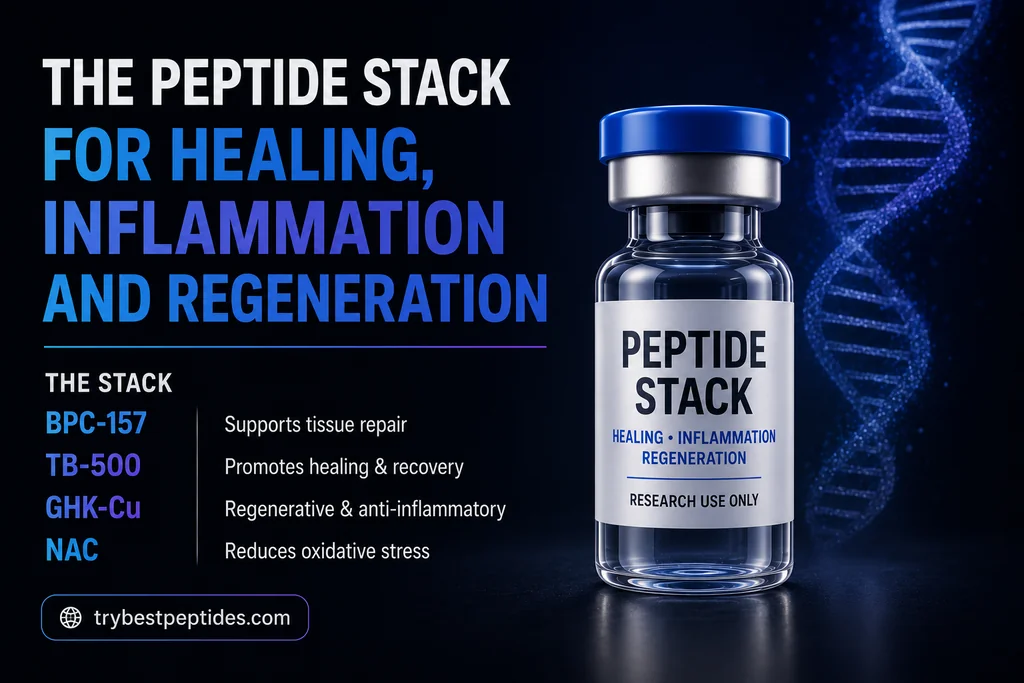
When you combine all four peptides—BPC-157, TB-500, GHK-Cu, and KPV—the theory becomes elegantly comprehensive:
- BPC-157 opens the highways (blood supply)
- TB-500 moves in the construction crews (cellular migration)
- GHK-Cu remodels the entire system beautifully (structural optimization)
- KPV keeps the dust settled (inflammatory control)
This is repair biology mapped to pharmaceutical precision. Each component addresses a different bottleneck. In theory, you're not just healing tissue—you're creating an optimal inflammatory environment for that healing to occur. The framework makes logical sense. Whether human biology performs exactly as this theory predicts remains an open question.
Practical Considerations and Individual Response
Popular peptide stacking attracts two types of practitioners: those who experience dramatic results and those who feel virtually nothing. This variability reflects both individual biochemistry and the incomplete state of peptide research in humans.
Receptor sensitivity varies tremendously between individuals. Your genetic background, current health status, existing inflammation levels, and even sleep quality influence how your receptors respond to peptide signals. Someone with acute inflammation and robust receptor sensitivity may experience transformation. Someone with chronically downregulated receptors might need dose escalation or receptor recovery protocols—adding complexity to an already complex intervention.
The research foundation matters too. While peptides have extensive pre-clinical data and animal model support, large-scale human clinical trials remain limited for most compounds. You're essentially working with educated theoretical frameworks rather than definitive clinical guidelines.
Key Considerations Before Stacking Peptides
If you're exploring peptide stacking, several principles deserve attention:
- Start with single peptides before combining them—this lets you assess individual response before introducing multiple variables
- Monitor receptor desensitization closely—if you notice diminishing effects over time, you may need to cycle or adjust doses
- Be aware of dose-response relationships—more isn't always better, and exceeding optimal doses can trigger unwanted effects or safety concerns
- Work with experienced practitioners—the peptide space includes both knowledgeable specialists and opportunistic marketers
- Track systemic effects carefully—peptides influence numerous biological pathways, and unexpected effects deserve attention
- Understand your goal precisely—are you treating acute injury, managing chronic inflammation, or optimizing tissue quality? Different stacks serve different purposes
Conclusion
Peptide stacking represents an intriguing application of molecular biology to human optimization. The science behind combination therapy—using complementary mechanisms to address multiple rate-limiting steps in a biological process—is sound. The Wolverine stack, glow stack, and close stack each build logically on the previous, adding layers of sophistication that address blood supply, cellular migration, structural remodeling, and inflammatory resolution.
However, elegant theory doesn't always translate to clinical reality. Individual responses vary significantly, receptor desensitization poses real risks with chronic use, and the human evidence base remains limited compared to pre-clinical research. If you're considering peptide stacking, approach it with scientific curiosity balanced by healthy skepticism. Learn what each peptide actually does at the molecular level. Understand your personal recovery bottlenecks. Start conservatively, monitor responses carefully, and be willing to adjust based on what your own biology tells you. The most sophisticated stacks in the world won't work if they're not matched to your specific situation. Stay curious, stay skeptical, and prioritize safety over hype.
Key Takeaways:
- Peptide stacking combines multiple compounds to target different aspects of tissue repair simultaneously—BPC-157 for blood supply, TB-500 for cell migration, GHK-Cu for structural remodeling, and KPV for inflammation control
- Receptor desensitization is a real concern when stacking peptides, particularly with extended use, and manifests as diminishing effects over time despite continued dosing
- Individual response to peptide stacks varies tremendously based on genetics, current health status, and receptor sensitivity, meaning some people experience transformative results while others feel minimal effects
- Starting with single peptides and progressing cautiously to stacks allows you to identify personal response patterns and avoid overwhelming your biological systems with multiple simultaneous signals
-